
Ask three suppliers for a ceiling trap door price in India and you may get three answers so far apart that they look like prices for three different products. In a sense, they are. One quote may be for a thin, home-use panel that simply covers a hole. Another may be for a standard aluminium panel with a proper frame and lock. A third may be for a large, custom, multi-shutter panel engineered to carry a heavy shutter, anchored to the concrete slab above, and finished invisibly into the ceiling. Comparing those three numbers side by side, as if the only difference were the supplier’s margin, is how projects end up with the wrong panel — or with a panel that sags, sticks, or has to be replaced.
This guide explains the spread honestly: what sits behind the low numbers, what a standard engineered panel costs and why, and why the largest panels are not priced off a shelf at all. It does not invent a Skyhatch price list. Where it gives a Skyhatch price, that price was checked live on Skyhatch’s own shop on 2 November 2026 and is dated as such. Where it quotes older market figures, it says so, and says where they came from. That distinction matters, because a price guide that blurs its sources is just another quote in the spread.
The direct answer
A ceiling trap door price in India is not one number because a ceiling trap door is not one product. Size, shutter count, hinge, lock, frame construction, finish and support each change what is actually being sold — and each change costs money to engineer, or saves money by leaving something out.
The short version is this. At the bottom of the market, you are usually buying a simple cover: a thin panel, a basic frame, a light latch, and no engineering for weight, repeated use or a flush finish. In the middle, a standard engineered panel such as Planea (CTD26) gives you a proper aluminium frame, a sliding hinge, a concealed lock, a jointed frame that can be adjusted on site, and a 2–2.5 mm shadow groove finish — and its stocked standard sizes are sold at a stated shop price. At the top, a large-format panel such as Zenith+ (CTD25) is made to the project’s own dimension, in single or multi-shutter form, anchored to the structure rather than hung from the ceiling grid — and because every unit is effectively a small project in itself, it is quoted for the size, finish and quantity you actually need.
If you take one rule from this guide, take this one: never compare two trap door prices until you have confirmed that both quotes are for the same size, the same hinge, the same lock, the same frame construction, the same finish and the same support. If any of those differ, you are not comparing prices. You are comparing products.
Where the ₹600 to ₹7,400 spread actually comes from
The headline range in this guide’s title needs its source stated plainly, because it is easy to misread. It does not come from Skyhatch’s price list, and it is not a verified current market range. It comes from trader and marketplace listings recorded in Skyhatch’s competitor research files of 26 October 2026, which collected per-piece listings from Delhi and Bengaluru sellers. In that set, the lowest listing found was ₹600 per piece for a 5 mm home-use panel from a Delhi seller, and the highest was ₹7,400 per piece from another Delhi seller. Between them sat listings at ₹1,200, ₹1,500, ₹1,850 and ₹2,800 per piece, mostly for generic aluminium or unspecified panels.
Two things follow from that attribution, and both matter. First, those figures are a snapshot from late October 2026, from trader listings, not from reputed manufacturers’ own price lists — so they should not be treated as today’s prices, and they are not recommendations in this guide. A trader listing can change, go out of stock, or describe a different product under a similar name, and this guide does not pretend otherwise. Second, the spread itself is still instructive, because it shows exactly the problem buyers face: a search for one product name returns prices spanning more than ten times from bottom to top, with almost no explanation of what changes between them. That is the gap this guide fills — not by adding another unexplained number, but by explaining what the numbers can hide.
The honest way to read that old spread is as a warning, not a shopping list. A ₹600 panel and a ₹7,400 panel were not the same panel at different markups. They differed in material thickness, in frame construction, in lock, in finish, and almost certainly in size — and the listing rarely told you which of those differences you were paying for. The sections below unpack each of those differences, so that the next spread of quotes you receive can be read properly, line by line.
What Skyhatch’s own shop actually shows today
Unlike the trader listings above, Skyhatch’s own shop prices can be checked directly, and they were checked for this guide on 2 November 2026. They are worth quoting precisely, with their pack sizes, because pack size is one of the easiest ways for two prices to look different while describing the same product.
For stocked standard sizes, the shop on that date showed the Planea 300×300 mm panel, pack of 1, at ₹2,090, and the Planea 1200×600 mm panel, pack of 1, at ₹5,699. It also showed Zenith+ shop listings at ₹9,000 against a struck price of ₹15,000 for the 900×900 mm and 1200×900 mm listings. Those are the prices as shown on the shop on 2 November 2026; sale prices in particular can change, so the product page at the time you order is the price that counts, not this guide’s snapshot. Pack-of-2, pack-of-3 and pack-of-4 Planea listings were also shown, at lower per-unit figures than the pack-of-1 price — which is exactly why a quote that omits the pack quantity cannot be compared with one that states it.
What the shop does not do is price every Zenith+ size. That is not an omission in the shop; it follows from the product. IQUBX, the manufacturer behind Skyhatch, states on its own technical page that Planea standard sizes are stocked and available through IQUBX, through distributors and online, while Zenith+ is made to order — you share the gypsum opening size, ceiling finish and quantity for a quotation. A panel made to 6000×2400 mm, in four shutters, anchored to a slab, cannot sensibly carry a single shelf price, because the size, shutter count and support are set by the project, not by a catalogue. The quote route is not a way of hiding the price. It is the price mechanism for a made-to-order product, and this guide treats it as such rather than inventing a figure to fill the gap.
There is one further verified fact from that same manufacturer page that belongs in any price discussion: IQUBX states that it supplies from a single unit upwards, with no minimum order quantity. For a buyer who needs one panel for one room, that matters more than any bulk discount, because it means a single standard panel can be ordered at its shop price without being forced into a project quantity.
The seven things that actually move the price
1. Size and shutter count
Size is the most obvious price driver and the easiest to get wrong. A 300×300 mm inspection panel and a 2400×6000 mm maintenance opening are not scaled versions of each other; they are different engineering problems. The small panel is a single shutter in a standard frame. The large opening is a multi-shutter assembly in which every shutter must slide aside, stay engaged with the frame, and leave the whole opening clear without a crossbar across it.
That is why the size question must be settled before the price question, and why this guide does not repeat the sizing rules here: the Ceiling Trap Door Sizes Guide explains the A-size versus B-size ordering rule — the visible opening versus the outer frame size — in full. Order the wrong size and the price discussion becomes academic, because the panel either does not fit the opening or does not fit the equipment that has to come through it. A cheaper panel in the wrong size is not a saving. It is a replacement waiting to happen.
2. The hinge: what holds the shutter while it opens
The hinge is where the cheapest panels save money most invisibly, and where the cost of saving it shows up latest. A conventional panel engages its shutter on hooks or extended flanges at two corners. At 600×600 mm that works well enough. Enlarged, it means the shutter has to be supported by hand, unhooked, carried down a ladder, stored, and lifted back into position — usually by one person working at height. IQUBX is explicit that what is convenient at small sizes becomes a handling and safety risk at large sizes.
Skyhatch’s sliding hinge, explained in full in Why Large Ceiling Trap Doors Fall, Sag and Get Carried Down Ladders — The Sliding Hinge Solution, moves the pivot as the shutter opens, so the shutter stays attached to the frame throughout and can slide aside instead of coming off. That mechanism has to be carried inside the aluminium sections themselves, which is why those sections are heavier and shaped to do several jobs at once. A panel without that mechanism can be cheaper to make. It is also a panel whose large shutter must be carried down a ladder every time it is serviced. The price difference is, in part, the price of not having to do that.
3. The lock: what holds the shutter shut
A lock looks like a small line item until it is asked to do the wrong job. A push lock is a light mechanism: press the shutter and it releases, press it shut and it catches. It is convenient, it needs no key, and on a standard panel it is exactly right. IQUBX states plainly that it is “a light mechanism, never intended to support a large, heavy shutter.” An Allen cam lock, by contrast, is built into the heavier profile of the large-format series and is, in the manufacturer’s words, designed for the load.
The full comparison — who should be able to open the panel, and which lock suits which shutter — is covered in the push lock vs Allen key lock guide, and this guide does not repeat it. For pricing, the point is simpler: a panel priced with a light latch cannot be compared with a panel priced with a load-appropriate cam lock as if the lock were a free choice. On Skyhatch’s own range, that choice follows the series — push lock standard on Planea, with an Allen key lock as an option, and Allen key lock on Zenith+ — so the lock cost is bound up with the series cost, not added as an afterthought.
4. The frame: jointed or crimped
A conventional access panel frame is crimped at the corners. Crimping is fast and cheap, and it is also final: a crimped frame cannot be opened up, cannot be resized, and cannot be reused. Skyhatch frames use cleats and brackets wherever structural rigidity is required, so the frame can be opened and reassembled, resized on site to accommodate dimensional variations, and reused when a space is reconfigured.
That jointed construction costs more to manufacture than a crimped corner, and it saves money in a different place: on site, when the opening as built differs by a few millimetres from the opening as drawn, or when a ceiling is reconfigured years later. A price that omits jointed construction is not necessarily a worse price for a perfect, never-changing ceiling. It is a worse price for a real ceiling, where dimensions vary and spaces change. Ask any quote whether the frame is jointed or crimped, and whether it can be resized on site — the answer tells you more about the value than the headline figure does.
5. Finish and infill: what you actually see
From below, a finished trap door should be almost invisible: a 2–2.5 mm shadow groove at the shutter-to-frame joint, no visible flange, and an infill finished in the same material as the surrounding ceiling. Skyhatch shutters accept 10–12 mm infill — MR gypsum board, pre-laminated board, WPC or PVC board, ACP, laminate, veneer on base board, calcium silicate board, or honeycomb panels — finished on site to match the ceiling.
That finish is part of what you are paying for, and it is also part of what a per-piece price may not include. Does the quoted price include the infill material itself, or only the frame and shutter? Does it include finishing the infill to match the ceiling, or is that the ceiling contractor’s separate scope? A panel that arrives without its infill finished is not a finished ceiling; it is a frame waiting for another trade. The cheapest quote is often the one that leaves the finishing to someone else, and the cost reappears in another contractor’s bill. The same logic applies to the ceiling system around the panel: the panel sits in a gypsum false ceiling in most projects, and Saint-Gobain Gyproc’s guide to false ceilings describes the systems these panels are most often fitted into — the context in which the finish has to work.
6. Support: what carries the weight
A small panel can fix to the ceiling subframe. A large panel cannot, and the price must reflect that. Skyhatch’s large-format panels are anchored to the true ceiling soffit — the RCC slab or roof structure — using GI strips, butterfly hangers or MS threaded rods, so the weight goes to the structure and never loads the false ceiling. The installation sequence that makes that work — frame fixed to the subframe before board, with slab hangers for large panels — is set out step by step in the gypsum-ceiling installation guide, and this guide does not repeat it.
For pricing, the question to ask is whether the quote includes the support hardware and the work of fixing to the structure, or only the panel itself. A large panel hung from ceiling framing instead of anchored to the slab is not a saving; it is, in the manufacturer’s own framing, one of the principal causes of failure around large ceiling openings. If a quote for a large panel is dramatically cheaper than the rest, check the support first. That is usually where the difference lives.
7. Certification, quantity and the rest of the specification
Two smaller drivers deserve a mention because they are often used to justify a premium without being explained. The first is certification: Skyhatch is certified GreenPro Ecolabel Type 1 by the Products and Services Council of the CII, a third-party verified, multi-criteria, life-cycle assessment rather than a self-declared claim, as described by CII GreenPro. For green-building projects — LEED, IGBC, GRIHA and similar submissions — that documentation has a real, auditable value, and it is part of what a certified panel’s price buys. It does not, by itself, justify any particular price premium figure, and this guide states none: certification is a property of the panel system, not a multiplier to be applied to a quote.
The second is quantity and pack size. A pack-of-4 price divided by four is not the same as a pack-of-1 price, and a project quantity of fifty panels is not priced like a single panel for one room — though, as noted above, IQUBX supplies from a single unit upwards, so a single panel is a real order, not a favour. When comparing quotes, always reduce each one to the same basis: price per panel, for the same size, same pack quantity, same lock, same frame construction, same finish scope, and same support scope. Anything less is not a comparison.
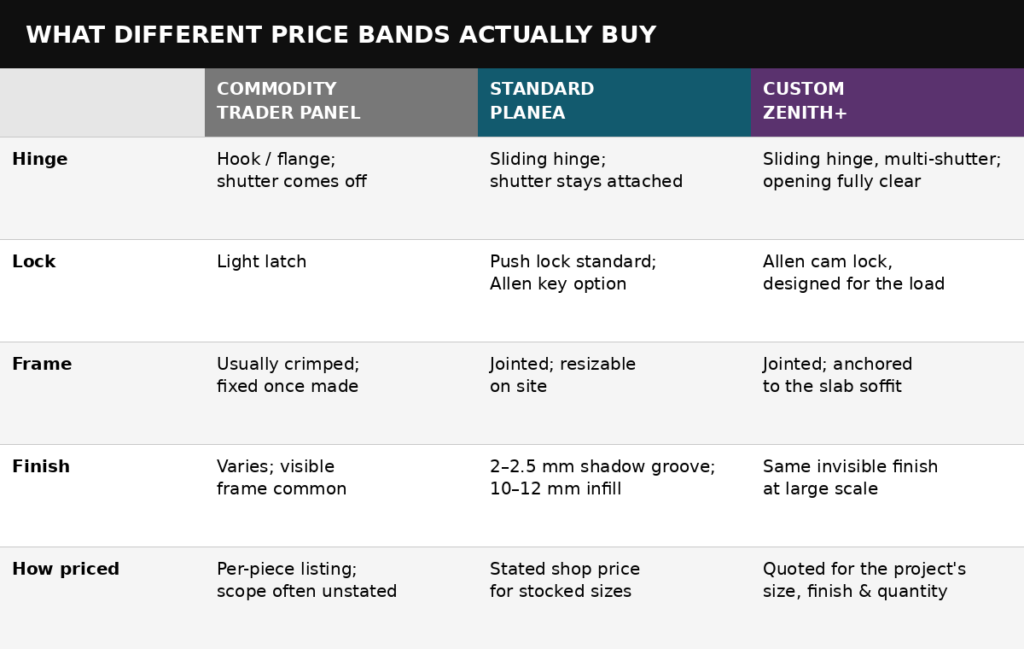
What the price bands actually buy: a side-by-side view
| Commodity trader panel | Standard engineered panel (Planea) | Custom large-format panel (Zenith+) | |
|---|---|---|---|
| Typical size | Small, often a single standard size | Stocked standard sizes, 300×300 to 1200×600 mm | Custom, to 6000×2400 mm and larger on request |
| Hinge | Hook or flange engagement; shutter comes off | Sliding hinge; shutter stays attached | Sliding hinge, multi-shutter; shutters slide aside, opening fully clear |
| Lock | Light latch or push catch | Push lock standard, Allen key lock as an option | Allen cam lock, designed for the load |
| Frame | Usually crimped; fixed once made | Jointed with cleats and brackets; resizable on site | Jointed; anchored to the slab soffit for large units |
| Finish | Varies; visible frame or flange common | 2–2.5 mm shadow groove; 10–12 mm infill matched to the ceiling | Same invisible finish at large scale |
| Support | Ceiling grid or subframe | Subframe fixing | MS threaded rods, GI strips or butterfly hangers to structure |
| How it is priced | Per-piece trader listing; scope often unstated | Stated shop price for stocked sizes (checked 2 Nov 2026) | Quoted for the project’s size, finish and quantity |
The table is deliberately qualitative about the trader column, because the trader listings recorded in October 2026 did not consistently state hinge, lock, frame or support — which is itself the point. A price without a specification is not a bargain. It is an unknown.
What a price usually does not include — ask before you compare
A per-piece panel price, even a clearly stated shop price, is rarely the whole cost of a finished, working trap door in a finished ceiling. Before you compare two numbers, ask each supplier these questions, and get the answers in the quote:
- Infill and finishing: Is the 10–12 mm infill material included, and is finishing it to match the surrounding ceiling included, or is that separate ceiling-contractor scope?
- Installation: Is installation included at all? If so, does it include the frame-first sequence and, for large panels, slab anchoring — or only fixing the panel into an already-prepared opening?
- Support hardware: For panels above 1200 mm, are MS threaded rods, GI strips, butterfly hangers or equivalent slab fixings included?
- Lock option: For a standard panel in a public area, is the Allen key lock option included in the price, or is the price for the standard push lock only?
- Delivery and quantity: Is delivery included, and is the price per panel or per pack? A pack-of-4 figure and a pack-of-1 figure must be reduced to the same basis before they can be compared.
- Custom sizing: For a non-standard size, is the price a stocked-size price, or does it include the custom fabrication? Custom Zenith+ sizes are quoted, not shelf-priced, for exactly this reason.
- After-sales scope: What happens if the opening as built differs from the opening as ordered? A jointed frame that can be resized on site answers that question differently from a crimped frame that cannot.
None of these questions is a trick, and a good supplier will answer all of them without hesitation. A supplier who cannot answer them is telling you something about the quote, even if the number looks attractive.
The cheapest-quote trap, stated plainly
The cheapest quote usually omits what the job actually needs — a hinge that holds a heavy shutter, a lock rated for the load, a frame that can be resized on site, or slab anchoring for a large panel — and the cost reappears later as sagging, a shutter that will not seat, a panel that cannot be opened safely, or a replacement. That is not a theoretical risk. It is the lifecycle story told at length in the guide to why site-fabricated ceiling trap doors are no longer good enough: a site-fabricated door looks economical until quality board, framing, hardware, carpenter labour, painting, finishing, repeated site adjustments and coordination are all counted, and the result is still a one-off product without standard engineering or lifecycle planning.
The same logic applies to a bought panel. The cheapest panel is not automatically the worst panel — a small, standard, well-made panel for a small inspection opening can be excellent value. The trap is not cheapness itself. The trap is cheapness achieved by leaving out the engineering that the opening actually requires, and discovering the omission only when the ceiling is finished and the panel is in daily use. Price bands are useful only when they are read as engineering bands: what hinge, what lock, what frame, what support, what finish. Read that way, a higher price is sometimes simply the price of the panel the job needs, and a lower price is sometimes the price of a different, smaller job.
How to compare quotes like for like
When the quotes arrive, do this before you look at the totals. First, write down the opening you actually need — the A-size, the visible opening, and the equipment that has to come through it — using the sizes guide, not a catalogue default. Second, reduce every quote to price per panel, same size, same pack quantity. Third, check the five engineering lines on every quote: hinge type, lock type, frame construction (jointed or crimped), infill and finish scope, and support method. Fourth, check the commercial lines: installation scope, delivery, and what happens if the as-built opening differs. Only then compare the numbers.
If a quote cannot be reduced to those lines — if it does not state the hinge, the lock, the frame or the support — treat it as incomplete, not as cheap. Ask for the missing lines. A supplier who can state them has given you a comparable quote. A supplier who cannot has given you a number, and a number without a specification is the most expensive kind of cheap.
For the manufacturer’s own technical grounding on all of this — the sliding hinge, the jointed frame, the soffit anchoring, the stocked-versus-made-to-order distinction and the single-unit supply position — see IQUBX’s Skyhatch ceiling trap door page. It is the source this guide’s engineering claims rest on, and it is the page to check first if any quote contradicts what is written here.
Frequently asked questions
Why is one ceiling trap door ₹600 and another ₹7,400?
Because those figures, as recorded in trader listings in October 2026, described different products, not the same product at different prices. They differed in size, material thickness, hinge, lock, frame construction and finish scope — and the listings rarely stated all of those differences. Treat the spread as evidence that specification matters, not as a current price list. For a current Skyhatch price, check the shop product page at the time you order.
What does a 600×600 trap door cost in India?
There is no single answer, because a 600×600 panel can be a thin commodity panel, a standard engineered panel, or one shutter of a larger assembly. As a dated reference point, Skyhatch’s shop on 2 November 2026 showed its stocked Planea panels at ₹2,090 for 300×300 mm (pack of 1) and ₹5,699 for 1200×600 mm (pack of 1), with pack-of-2, 3 and 4 listings at lower per-unit figures. A 600×600 figure should be checked on the shop product page for that exact size and pack, and reduced to price per panel before it is compared with any other quote.
Is a cheap trap door safe for a large opening?
Not on the basis of price alone. Safety for a large opening comes from the hinge (does the shutter stay attached?), the lock (is it designed for the load?), the frame (is it jointed and resizable?) and the support (is it anchored to the slab, not hung from the ceiling grid?). A light push lock, in the manufacturer’s own words, is never intended to support a large, heavy shutter. If a cheap quote does not state those four things, it has not answered the safety question.
Why is a large-format trap door quoted instead of priced?
Because it is made to order for the project: its size is set by the equipment that must come through it, its shutter count by the width of the opening, and its support by the structure above. IQUBX states that Zenith+ is made to order and that a quotation follows from the gypsum opening size, ceiling finish and quantity. A single shelf price for every possible custom size would be a fiction, so the honest mechanism is a quote for the actual unit.
What is included in a trap door price — and what is not?
It depends on the quote, which is why this guide lists the questions to ask: infill material and finishing, installation scope, support hardware for large panels, the lock option, delivery, and pack quantity. A shop price is the price of the panel as listed; installation and ceiling finishing are commonly separate scope. Get each item stated in the quote rather than assuming it is included.
Does a higher price always mean a better trap door?
No. A higher price for the wrong size, the wrong lock or an unnecessarily large panel is wasted money, and a standard panel at a stated shop price can be exactly right for a standard inspection opening. Price is a signal only when the specification is held constant. Compare like with like, on the five engineering lines and the commercial lines above, and the right price for the job usually becomes clear.
Should I buy the cheapest panel for a home?
For a small, private, standard inspection opening — a valve, a junction box, a ductable AC service point — a standard stocked panel at its shop price is often the right choice, and there is no need to pay for large-format engineering you do not need. The cheapest-quote trap applies when the opening is large, heavy, public, or load-bearing in a way the cheap panel was not engineered for. Match the panel to the opening, not to the lowest number.
Conclusion
Ceiling trap door prices in India spread widely because ceiling trap doors themselves spread widely — from a thin cover for a small hole to a custom, multi-shutter, slab-anchored assembly for a plant room. The spread is not a mystery to be solved by finding the lowest number. It is a specification to be read: size first, then hinge, lock, frame, finish and support, and only then price, reduced to the same basis across every quote.
For a standard opening, check the stocked size and its stated shop price, confirm the pack quantity and the lock option, and confirm what installation and finishing scope sits outside the panel price. For a large or custom opening, do not look for a shelf price that does not exist: note your opening size, your ceiling finish, your shutter count and your quantity, and ask for a quotation on that exact specification. That is how a price guide should end — not with a number, but with a specification good enough that any number you are given can actually be judged.
If you are specifying now, the next step is simple: decide the opening the equipment actually needs, check the standard sizes on the Planea product page or the large-format range on the Zenith+ product page, and then request a quote with your opening size, ceiling finish, shutter count and quantity, so the price you receive is for the panel you need — not for a different product that happens to share its name. For the full system overview behind this guide, see the Complete Guide to India’s most advanced modular ceiling trap door.