
Walk into a finished office, hospital corridor or hotel lobby and look up. If the ceiling was done well, you will see nothing at all where the access panel sits — just a fine shadow line in an otherwise unbroken surface. That invisibility is the point of a modern ceiling trap door. But it raises a question that only occurs to people later, usually at the worst possible moment: who can actually open that panel, and will it stay shut?
A maintenance engineer called out at midnight needs to get above the ceiling quickly. A curious visitor in a public corridor should not be able to do the same thing by accident. And on a very large panel, the lock has a second job that has nothing to do with keys at all: it has to hold a heavy shutter closed, reliably, for years.
This guide answers that question properly. It explains what a push lock and an Allen key lock each do, where each one belongs, and — importantly for Skyhatch buyers — why the choice is mostly made by the panel series and size you need, not picked freely like a colour.
The direct answer
For a standard-size panel in a private or staff-only area, a push lock is the convenient default: press, and the shutter releases. For the same standard panel in a public area, where you do not want anyone to be able to open it without a key, the Allen key lock option is the right call. For a large, heavy or multi-shutter panel, the Allen key lock is not a preference at all — it is the lock the large-format series uses, because a push lock is a light mechanism that the manufacturer does not intend to hold a large, heavy shutter.
In Skyhatch terms, that maps neatly onto the two series. Planea (CTD26) comes with a push lock as standard and offers an Allen key lock as an option. Zenith+ (CTD25) uses an Allen key lock, described on its product page as secure for large, heavy shutters. So in practice, you usually settle the lock when you settle the size and the series — and the rest of this guide shows you how to think through that decision, room by room.
What a push lock actually is
A push lock is exactly what it sounds like. You press the shutter, the latch releases, and the panel opens. Press it closed again and it catches. There is no key to find, no tool to carry, and nothing to lose.
That simplicity is its whole appeal. In a home, a small office, or a plant room that only your own maintenance staff enter, the person who needs access is usually the person standing underneath the panel. A push lock removes friction from a routine job: checking a valve, resetting a detector, looking at a duct joint. The panel opens in seconds, and — this matters — it closes just as easily, which means it is more likely to actually be closed properly after the job instead of left ajar.
The trade-off is equally simple, and it is the one people most often miss: anyone who knows how it works can open it. A push lock is not a security device. It keeps a panel neatly shut; it does not control who opens it. In a private flat or a locked plant room, that distinction rarely matters. In a hotel corridor, a hospital ward, a shopping mall or a school, it matters a great deal.
There is a second, less obvious limit, and it comes from the manufacturer rather than from common sense. IQUBX, the manufacturer behind Skyhatch, is blunt about it on its technical page: the push lock “is a light mechanism, never intended to support a large, heavy shutter.” A light latch can hold a small shutter closed perfectly well. Ask it to hold a large, heavy shutter closed, and you are asking a small mechanism to do a job it was never designed for. That is not a criticism of push locks — it is a statement about where they belong.
What an Allen key lock actually is
An Allen key lock — also called an Allen cam lock — works differently. The shutter is released by turning a key, an Allen key, in a cam mechanism. Without the key, the panel does not open with a push. Whoever holds the key controls access.
That single fact changes how a building is run. Keys can be issued to a facility team, held at a reception desk, or kept by a contractor, and everyone else — guests, patients, shoppers, visitors — simply cannot open the panel casually. It is access control, not high security in the sense of a safe or a vault, and this guide makes no claim beyond that: an Allen key lock means a key is needed to open the panel. It is not presented here as tamper-proof, theft-proof or child-proof, because no such rating has been verified for these panels.
On large panels, the Allen cam lock has a second advantage that has nothing to do with keys. IQUBX puts it this way: “Large shutters can be secured with Allen cam locks designed for the load, instead of light push locks.” The cam mechanism is built into the heavier profile of the large-format series, and it is the load-appropriate lock for a shutter that is bigger and heavier than a standard panel. That is why the large-format series uses it as standard, not as an upgrade.
One correction before you choose: neither lock shows on the ceiling
If you have ever seen an old access panel with an ugly keyhole drilled through its face, you might assume the choice here is between a neat push panel and a panel spoiled by a visible keyhole. For Skyhatch, that assumption is wrong, and it is worth correcting plainly because it changes the whole decision.
IQUBX states that the Allen cam lock on Zenith+ and the push lock on Planea “both sit within the profile rather than being added to it, which is why neither shows on the face of the shutter.” With Planea’s push lock, there is no visible keyhole at all. Once the panel is finished in the same material as the surrounding ceiling, all you see is the 2–2.5 mm shadow groove at the shutter-to-frame joint.
So the real question is never “which lock looks better?” They look the same from below: invisible. The real questions are “who should be able to open this panel?” and “is this lock right for a shutter of this size and weight?” Everything that follows is built around those two questions.
Push lock vs Allen key lock: side by side
| Push lock | Allen key (cam) lock | |
|---|---|---|
| How it opens | Press the shutter; the latch releases | Turn an Allen key in the cam mechanism |
| Who can open it | Anyone who knows how it works | Only someone holding the key |
| Visible on the ceiling face | No — sits within the profile; no visible keyhole on Planea | No — sits within the profile; neither lock shows on the face |
| Standard on | Planea (CTD26), standard-size series | Zenith+ (CTD25), large-format series |
| Available as an option on | — (standard on Planea) | Planea, as an optional Allen key lock |
| Best for | Routine access in private or staff-only areas | Public areas, and all large, heavy or multi-shutter panels |
| Limit to respect | A light mechanism — not intended to hold a large, heavy shutter | Needs a key, so keys must be issued and kept track of |
The two questions that settle it
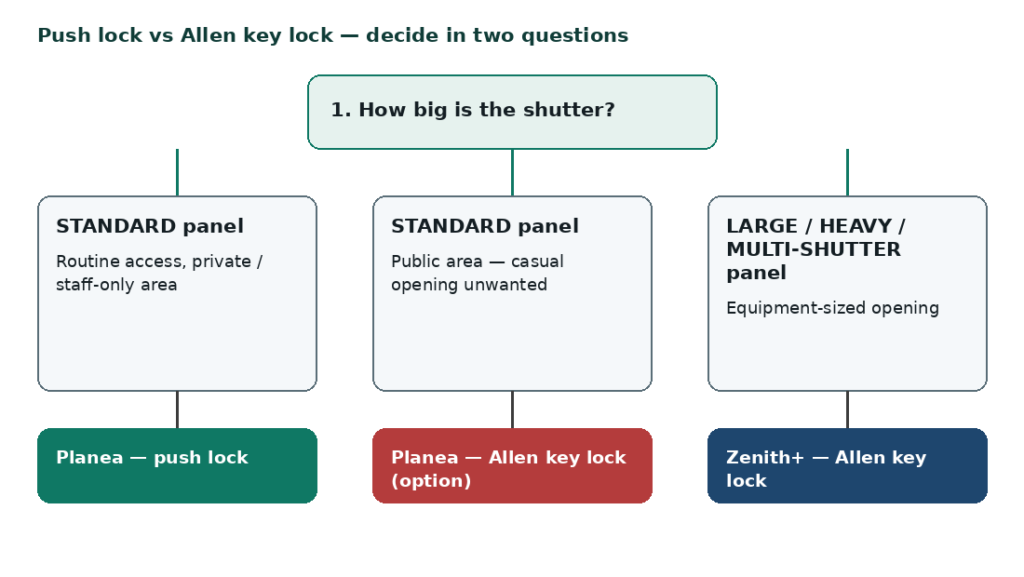
Forget the lock for a moment and ask two questions about the room the panel sits in. The answers will point you to the right row of the table above.
1. Who will be underneath this ceiling?
If the answer is “only our own people” — a home, a private office, a locked plant room, a back-of-house corridor — then convenience wins, and a push lock is the sensible default. The people who need access already have legitimate access to the room, and the fastest opening is the best opening.
If the answer includes the general public, guests, patients or anyone passing through — a hotel corridor, a hospital ward, a mall, an airport, a school, a restaurant dining area — then access control wins. A panel that any passer-by can push open is a panel that will eventually be pushed open, whether out of curiosity or by accident. That is not a hypothetical risk: above a public ceiling sit electrical distribution, fire protection valves, dampers and ductwork that should only be touched by people who know what they are doing. For a standard panel in that setting, Planea with the optional Allen key lock gives you the same invisible finish with key-controlled access.
One practical note for facility teams: key control only works if the keys are actually controlled. Decide before handover who holds the Allen keys, where spares live, and what happens when a contractor changes. A keyed lock whose keys are taped to the frame is a push lock with extra steps. This is a management habit, not a product feature, but it is the difference between the system working and not working.
2. How big and heavy is the shutter?
This question overrides the first one. A standard Planea panel — stock sizes from 300×300 mm to 600×1200 mm, made to order from 250×250 mm — is a single shutter of a size a push lock holds comfortably. A Zenith+ panel is a different animal: custom sizes from 900×1500 mm up to 5500×2400 mm and beyond, in single or multi-shutter configurations of two, three, four or more panels, anchored to the structural slab with MS threaded rods or flat hangers above 1200 mm. Its product page lists an Allen key lock and no push-lock option, and the manufacturer’s reasoning is the load logic quoted above: a light mechanism is not the right lock for a heavy shutter.
So if your opening is set by equipment — an air handling unit, a large damper bank, a plant-room service that has to come out through the ceiling — the lock decision is already made for you. You are specifying Zenith+, and Zenith+ means an Allen key lock. That is not a restriction to work around; it is the correct engineering answer to the size you need. For help settling that size in the first place, see the Ceiling Trap Door Sizes Guide, which explains the A-size versus B-size ordering rule, and note that this lock guide deliberately does not repeat that sizing detail.
Do not confuse the lock with the hinge
This is the misunderstanding that causes the most confusion in ceiling access, so it is worth one clear paragraph. The lock keeps the shutter shut. The hinge keeps the shutter attached while it opens. They are different mechanisms doing different jobs.
Skyhatch’s sliding hinge — explained in full in Why Large Ceiling Trap Doors Fall, Sag and Get Carried Down Ladders — The Sliding Hinge Solution — is what stops a large shutter from having to be carried down a ladder. The shutter slides aside while staying engaged with the frame, and a steel safety wire provides retention on Zenith+ shutters. The lock, whether push or Allen, is what holds that shutter closed when it is not being opened. A push-lock panel is not unsafe because its lock is light; its shutter cannot fall free because the sliding hinge and retention, not the lock, hold it. And an Allen-lock panel is not “permanently locked”; the shutter can still be removed deliberately when full access, realignment or a bigger opening requires it. Keep the two jobs separate in your specification, and both decisions get easier.
Choosing room by room
Homes and private rooms. A standard panel over a ductable AC unit, a valve or a junction box, in a ceiling only the household sees: Planea with its standard push lock. Quick access, no key to hunt for, invisible finish. This is also the panel covered in the step-by-step gypsum-ceiling installation guide, which shows the frame-first sequence that keeps the finished panel sitting flush.
Offices and staff-only plant rooms. Same logic, with one addition: if the room is shared by several tenants or contractors, consider the Allen option even on a standard panel, purely so that access is a deliberate act by a keyholder rather than a casual push. The cost of that choice is a key to manage; the benefit is a record, in practice, of who could have opened the panel.
Hotels, hospitals, malls and other public buildings. Key-controlled access as the default, on every panel the public can reach. In a hospital, that also protects hygiene and safety: a panel above a ward or a clean area should not be openable by a passer-by. In a hotel, it protects the guest experience — a panel that cannot be idly opened is a panel that stays flush, finished and unnoticed. On standard panels, that means Planea with the optional Allen key lock; on large panels over AHUs and plant, it means Zenith+ with its standard Allen key lock.
Plant rooms and large-format openings. Zenith+ with its Allen key lock, full stop. The opening is set by the equipment, the shutters are large and heavy, the frame is anchored to the slab rather than hung from the ceiling grid, and the lock must suit the load. If you are specifying at this scale, the Complete Guide to India’s most advanced modular ceiling trap door gives the full system overview, and the lock choice follows from the series choice, not the other way round.
What to tell your supplier
When you enquire, the lock is one line in a short specification — but it is a line worth getting right. Tell the supplier four things: the opening size you need (or the equipment that sets it), the ceiling type and finish (the shutter carries 10–12 mm of the same material as the surrounding ceiling, so it disappears into the finish), who should be able to open the panel, and whether the panel is in a public area. With those four facts, the supplier can confirm the series and, for a Planea panel, whether you want the standard push lock or the optional Allen key lock.
A word of caution on that option: this guide recommends the Planea Allen key option only as listed on the live Planea product page at the time of writing — “push-lock standard, optional Allen key lock.” Confirm the option is still offered, and whether it changes anything about your order, when you enquire. No price, lead time or lock rating is stated in this guide, because none has been verified for publication here; those are questions for the quote stage, not assumptions for a buying guide.
For green-building projects, one further note: both series carry the GreenPro Type 1 Ecolabel, as described by CII GreenPro, which evaluates products on a life-cycle basis. The lock choice does not change that certification — it is a property of the panel system — but it is worth recording in the same specification, so the sustainability documentation and the access specification travel together. And because the panel sits in a finished ceiling, the ceiling system itself matters too: Saint-Gobain Gyproc‘s guide to false ceilings describes the gypsum false-ceiling systems these panels are most often fitted into, which is the context the gypsum installation guide above assumes.
Frequently asked questions
What is a push lock on a ceiling trap door?
A latch that releases when you press the shutter, and catches again when you press it shut. It needs no key or tool, which makes routine access fast, but it also means anyone who knows how it works can open the panel.
What is an Allen key lock on a ceiling trap door?
A cam lock released by turning an Allen key. Without the key, the panel cannot be opened with a push, so access is limited to keyholders. On Skyhatch’s large-format Zenith+ series it is also the load-appropriate lock for large, heavy shutters.
Can anyone open a push-lock panel?
Yes, in practical terms. Anyone who knows to press the shutter can open it. That is fine in a private or staff-only area and the wrong choice for a panel in a public corridor, ward or mall, where the Allen key option or a Zenith+ panel is the better specification.
Which lock is right for a large ceiling panel?
The Allen key lock. Large, heavy and multi-shutter panels use the Allen cam lock as standard on Zenith+, because a push lock is a light mechanism not intended to hold a large, heavy shutter. If your panel is large, the series decision settles the lock decision.
Does a Skyhatch lock show on the ceiling face?
No. Both locks sit within the profile rather than being added to it, so neither shows on the face of the shutter, and Planea’s push lock has no visible keyhole. What you see is only the 2–2.5 mm shadow groove at the shutter-to-frame joint, once the infill is finished to match the ceiling.
Can I change the lock later?
The honest answer is: ask at the quote stage, for your specific panel. Planea is listed with an Allen key lock as an option alongside its standard push lock, so the choice is made when you order; whether an existing panel can be converted afterwards depends on the panel as supplied, and this guide does not assume a retrofit path that has not been verified. If key control might matter later — a room changing from private to public use, for example — specify the Allen option now rather than hoping to change it later.
Is an Allen key lock more secure than a push lock?
It controls access better, because a key is needed to open the panel. This guide does not claim a tested security rating, tamper-proofing or theft-proofing for either lock, because none has been verified. If a project needs a rated security assembly, that is a different product requirement to raise with the supplier explicitly.
Does the lock affect the panel’s green certification?
No. GreenPro Type 1 Ecolabel certification applies to the panel system on both series, regardless of which lock is fitted. Record the certification and the lock choice as separate lines in the same specification.
Conclusion
Choose the lock by answering two questions in order. First, how big is the shutter? If it is large, heavy or multi-shutter, the answer is the Allen key lock on Zenith+, because that is the load-appropriate lock for that panel. Second, who should be able to open it? If the answer is “only keyholders,” choose the Allen key option even on a standard Planea panel. Only if the panel is standard-size and in a private or staff-only area does the push lock become the right default — and there, its speed and simplicity are genuine advantages, not compromises.
Get those two questions right, and the lock stops being a detail you worry about after installation. The panel stays invisible from below, opens when the right person needs it to, stays shut the rest of the time, and never asks a light latch to hold a heavy shutter.
If you are specifying now, the next step is simple: note your opening size, your ceiling type and finish, and who should (and should not) be able to open the panel — then request a quote with those details, so the series and the lock are confirmed together. For the manufacturer’s own technical explanation of how the two locks sit within the profile, see IQUBX’s Skyhatch ceiling trap door page.